
How to Develop a Sales Strategy: A Step-by-Step Guide for B2B Businesses
In the high-stakes world of B2B commerce, "winging it" is not a scalable growth plan. Without a documented sales strategy, even the most talented sales teams find themselves trapped in a cycle of inconsistent revenue, long sales cycles, and missed targets.
A robust B2B sales strategy is more than just a list of goals; it is a comprehensive roadmap that aligns your team, defines your ideal customers, and provides the tactical playbooks necessary to win.
In this guide, we will walk you through the four-pillar framework to develop a sales strategy that converts, including a one-page checklist to keep your team on track.
The Core Framework: 4 Pillars of a High-Growth Sales Strategy
Before diving into the "how," you need to understand the "what." A modern B2B sales strategy is built on four essential pillars:
1. The Sales Audit (The Foundation)
You cannot plan for where you are going until you know exactly where you are. A sales audit examines your current performance, team capabilities, and existing bottlenecks.
● What to analyse: Conversion rates at each funnel stage, average deal size, and sales cycle length.
● The Goal: Identify the gap between your current state and your revenue targets.
2. The Sales Model (The Engine)
Your sales model defines how you sell. Are you an inside sales organization focused on high-volume, low-touch deals? Or an enterprise field sales team managing complex, multi-stakeholder accounts?
● Key components: Defining your Ideal Customer Profile (ICP), choosing your sales methodology (e.g., Challenger, MEDDIC), and setting your pricing/packaging.
3. The Sales Playbooks (The Mechanics)
Playbooks are the repeatable instructions your reps use to execute the strategy. Without them, every rep is running their own experiment.
● Essential Playbooks: Prospecting/Outreach, Discovery & Qualification, Objection Handling, and Closing.
4. KPIs & Governance (The Dashboard)
What gets measured gets managed. You need a data-driven framework to track progress and hold the team accountable.
● Metrics that matter: Pipeline velocity, win rates, and Customer Acquisition Cost (CAC).
Step-by-Step: How to Develop a Sales Strategy
Step 1: Define Your Ideal Customer Profile (ICP)
The most common mistake in B2B sales is trying to sell to everyone. High-growth companies focus on the "Goldilocks" accounts - those that are the perfect fit for the product and have the budget to pay for it.
● Firmographics: Industry, company size, revenue, and geography.
● Technographics: What tools do they already use that your product complements?
● Pain Points: What specific business problem does your solution solve better than anyone else?
Step 2: Map the Buyer’s Journey
In B2B, the buyer's journey is rarely linear. It involves multiple stakeholders (the "Buying Committee"). Your strategy must account for:
Awareness: The buyer realizes they have a problem.
Consideration: The buyer researches potential solutions.
Decision: The buyer compares specific vendors.
Step 3: Align Sales and Marketing
A sales and marketing strategy must be unified. If marketing is generating "leads" that sales can't close, the strategy is broken. Ensure both teams agree on the definition of a Marketing Qualified Lead (MQL) and a Sales Qualified Lead (SQL).
Step 4: Build Your Tech Stack
Your strategy is only as good as the data supporting it. At a minimum, your B2B sales strategy needs:
● CRM (Customer Relationship Management): (Salesforce, HubSpot, etc.) to track every interaction.
● Sales Intelligence: (LinkedIn Sales Navigator, Apollo) to find the right prospects.
● Enablement Tools: To host your playbooks and training materials.
If you need help building these foundational elements, our Sales Consultancy Service provides expert-led audits to identify your biggest growth levers.
The 12-Month Sales Strategy Roadmap
A strategy is not a "set it and forget it" document. It requires phased implementation.
Quarter 1: The Audit & Alignment
● Conduct a full sales audit.
● Redefine the ICP and Buyer Personas.
● Audit the current CRM data for accuracy.
Quarter 2: Playbook Development & Training
● Document the "Winning Way" - your core sales playbooks.
● Roll out training sessions for the team.
● Note: For hands-on implementation support, consider our [Training Academy](/training-academy) to ensure your team actually adopts the new processes.
Quarter 3: Lead Generation & Pipeline Building
● Launch new outbound prospecting sequences.
● Implement a "Sales-Qualified Lead" feedback loop with marketing.
● Focus on increasing pipeline velocity.
Quarter 4: Optimization & Forecasting
● Analyse win/loss data to refine the pitch.
● Adjust quotas and compensation plans for the following year.
● Scale successful tactics and cut underperforming channels.
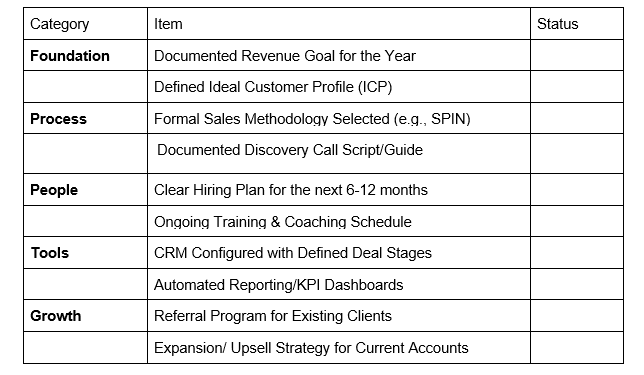
One-Page Sales Strategy Checklist
Use this checklist to ensure your strategy covers all the critical bases.
Conclusion: Turning Strategy into Revenue
Learning how to develop a sales strategy is the first step toward predictable B2B growth. However, the best strategy in the world is useless without disciplined execution.
Most businesses fail not because their strategy is bad, but because they lack the objective "outside-in" perspective needed to spot hidden inefficiencies.
Ready to build a winning sales engine?
Book a Free Sales Audit: Let our consultants look under the hood of your sales process and identify exactly where you are losing revenue.
Contact Us Today for a Sales Audit